

Itchy ears can be an annoying and persistent condition that affects many people. In a survey conducted in Spain in 2013, 62.7% of 1000 respondents claimed to suffer from itchy ears frequently. 31.4% of them felt more irritable due to itching.
Whether caused by environmental factors, allergies, or infections, the discomfort can disrupt daily life and lead to excessive scratching. Which may worsen the situation. Many otolaryngologists treat this process with low-potency topical steroids, but this treatment is not always effective. Topical moisturizers with key active ingredients such as Hyaluronic Acid (HA) provide a valuable alternative to treat itchy ears.
Why do ears itch?
Itchy ears stem from various causes, ranging from mild irritations to more serious dermatological conditions. One of the most common reasons is dryness, where the lack of moisture in the ear canal leads to irritation and a persistent itchy sensation. The skin inside the ear is delicate and, like other areas of the body, relies on a balanced level of hydration to maintain its barrier function.
Other contributing factors to itchy ears include:
- Earwax buildup: A blockage of earwax can cause itching and discomfort inside the ear canal. When foreign objects, like cotton swabs, are inserted into the ear, they can inadvertently push earwax deeper into the ear canal, potentially resulting in impaction and persistent ear itching.
- Infections and dermatological conditions: These include infections like otitis externa (swimmer’s ear) that can cause inflammation and intense itching and otic eczema, psoriasis, or other dermatoses of different origins affecting the delicate skin inside the ears.
- Use of earphones or hearing aids: These devices can trap moisture and prevent proper ventilation, increasing the risk of irritation and exacerbating conditions like dermatitis.
- Allergic reactions: Related to food, skin, or seasonal factors like spring and fall allergies, can affect the ears, giving rise to the familiar and unwelcome sensation of itchiness.
Excessive scratching can introduce bacteria into the ear, increasing the risk of infections and further complicating the issue. Addressing the root cause of the itchiness is essential to finding a long-term solution, and this is where hydration and skin barrier reinforcement come into play.
Hyaluronic acid locks in moisture and hydrates
Using topical moisturizers improves the barrier function of the skin’s outermost layer and reduces the frequency and severity of eczema episodes, as well as the need for topical steroids. Restoration of epidermal functions is possible thanks to the presence of active ingredients such as hyaluronic acid.
Hyaluronic acid is a naturally occurring glycosaminoglycan found in connective tissues, skin, and bodily fluids. Its primary function is to retain moisture and provide structural support to the extracellular matrix. What makes HA particularly beneficial for skin health is its ability to bind up to 1,000 times its weight in water, making it an ideal ingredient for maintaining hydration levels.
High molecular weight hyaluronic acid (HMW-HA) is particularly effective at forming a protective film over the skin, preventing water loss and enhancing the skin’s natural barrier function. Unlike low molecular weight HA, which penetrates deeper into the skin to stimulate cellular activity, HMW-HA remains on the surface, offering immediate hydration and soothing effects. This film-forming property is crucial for dry and irritated skin, as it reduces transepidermal water loss (TEWL) and locks in moisture. Studies have shown that HA can help support the regeneration of damaged skin, making it a valuable ingredient in skincare and dermatological treatments.
Beyond skincare: Hyaluronic acid in ear care product formulations
The benefits of HA in skincare formulations have long been known. In 2024, the total market of HA (pharmaceuticals, beauty, and personal care) was worth 11 billion dollars. It is expected to grow at a CAGR of 8.8% from 2025 to 2033. The increasing market is a clue of its potential due to its properties, and it is not strange that hyaluronic acid is emerging as a key ingredient in ear care products designed to address itchiness.
Mitelos has conceived and developed OTIKEEN®, a new treatment with a corticosteroid- free formulation that has moisturizing, nourishing, repairing and soothing properties. OTIKEEN® includes High Molecular Weight Hyaluronic Acid. Thanks to its exceptionally strong water absorption property HMW-HA can hydrate both the stratum corneum and the dermis.
Besides HA, its vegetable-origin oils and moisturizing active ingredients restore the skin barrier and soothe itching. These actions actively retain water in the skin, thanks to panthenol, and passively, thanks to the film-forming properties of its oils.
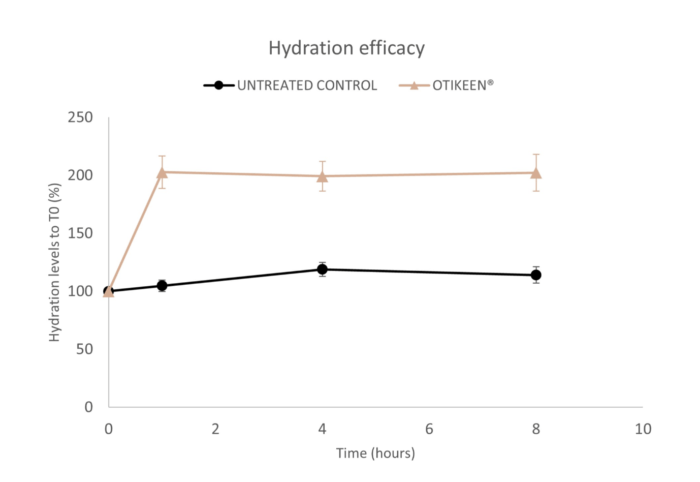
OTIKEEN® has been clinically proven to have moisturizing, nourishing, repairing, and soothing properties. In a hydration clinical study, OTIKEEN® significantly increased the hydration of the epidermis after a single application by +98pp (1st hour), +80pp (4th hour), and +88pp (8th hour), compared to the control.
At Mitelos, we are always looking for partners to help them fuel their portfolio. If you are interested in partnering with us to distribute OTIKEEN®, do not hesitate to contact us!

Sources
Asensio Nieto C. Eccema ótico. Repercusión en la calidad de vida del paciente y en los costes de atención sociosanitaria [Ear eczema. Impact on patient quality of life and healthcare costs]. Aten Primaria. 2015 Jan;47(1):67-8. Spanish. doi: 10.1016/j.aprim.2014.04.007.
Global Hyaluronic Acid Products Market Size, Share, Trends and Growth Analysis Report—Segmented By Product Type, Application and Region—Industry Analysis From 2025 to 2033. Market Data Forecast [Internet]. [Accessed Feb 7, 2025]. Available from: https://www.marketdataforecast.com/market-reports/hyaluronic-acid-products-market
Juncan AM, Moisă DG, Santini A, Morgovan C, Rus LL, Vonica-Țincu AL, Loghin F. Advantages of Hyaluronic Acid and Its Combination with Other Bioactive Ingredients in Cosmeceuticals. Molecules. 2021 Jul 22;26(15):4429. doi: 10.3390/molecules26154429.