



Wet and dry earwax types: genetic basis, clinical implications, and OTC product fit
Human earwax exists in two biochemically distinct forms, wet and dry, determined by a single gene and diverging in composition. Wet cerumen carries a notably higher lipid content, which shapes its stickier texture and darker colouring as it ages; dry cerumen has a lower lipid and higher protein share, which explains why it tends to flake into brittle, grainy fragments rather than form a cohesive mass. Understanding what drives this genetic split, and how each of these earwax types typically presents, is the starting point for positioning OTC ear drops and other solutions with the right consumer and the right evidence behind each claim.
Wet and dry earwax types: what the ABCC11 gene determines and why it matters
Wet and dry cerumen are the two outcomes of one gene: ABCC11. On chromosome 16, it encodes an ATP-binding cassette transporter responsible for exporting lipids across the membrane of the ear canal’s secretory glands. A single-nucleotide polymorphism decides the genotype:
- GG or GA genotype: functional transporter, higher lipid output, which leads to wet, sticky cerumen.
- AA genotype: reduced transporter activity, lower lipid content, which leads to dry, flaky cerumen.
The G allele (wet) is dominant, and inheritance follows simple Mendelian patterns confirmed across multiple family studies. This also answers whether wet or dry earwax is more common, depending on geography: the A allele (dry) reaches roughly 95% in East Asian populations and falls to 10-20% in European and African populations. Type is genetically fixed and largely stable, though prevalence could shift slightly with age.
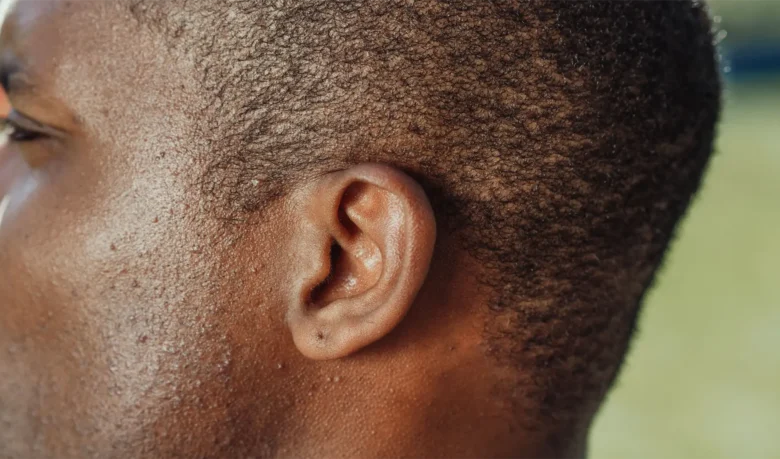
How genetics affects earwax color: from pale and flaky to dark and sticky
Colour is a downstream consequence of the same genetic divergence described above, rather than a separate variable. Freshly secreted cerumen is colourless; pigmentation develops afterwards through oxidation and the accumulation of shed skin cells. Because wet-type cerumen carries a substantially higher lipid fraction and dry-type a higher protein fraction, the two forms settle into distinct, genotype-linked colour ranges as this process runs its course, which explains most earwax color meaning queries:
- Dry-type earwax is consistently described in the literature as brittle, grey to tan; earwax yellow tones are typical, low-pigmentation presentations of this composition.
- Wet-type is described as sticky, ranging from yellowish-brown to dark brown earwax; darker shades reflect the lipid-rich substrate and longer residence time in the canal.
Because these colour ranges track genotype rather than a modifiable behaviour, they hold reasonably stable for a given individual over time.
Earwax buildup and blockage: how cerumen type affects OTC ear drops efficacy
Earwax buildup occurs in both types (actually, roughly one in five adults over 12 experience some earwax blockage), but drier cerumen is documented to be harder for the canal to clear on its own, whether that dryness comes from age-related gland decline or the inherited dry-type gene. The other well-documented risk factors are more anatomical and mechanical than genetic: overproduction relative to clearance, and obstruction from hearing aids or earplugs.
Earwax buildup symptoms typically include aural fullness, mild hearing loss, tinnitus, pain, and itching, and these present similarly across both cerumen types. Interfering with the canal’s natural clearance, through cotton buds or hearing aids, packs wax further in. This mechanical disruption is behind most earwax impaction from bad practices, independent of the phenotype question above.
The same question extends to treatment. Whether cerumen phenotype affects how well a given over-the-counter (OTC) solution formulation performs has also been proposed in the clinical literature, though not yet confirmed. The safest bet is therefore a formulation built for consistency and safety across the population, ahead of any phenotype-specific claim.

Earwax treatment and OTC product selection: a portfolio guide for consumer health brands
This kind of biological nuance rarely makes it onto pharmacy shelves, and it points to a simple strategic conclusion: good formulation design accounts for this variation, rather than multiplying it into separate product lines.
- Positioning: a formulation built for consistency and safety across the population serves consumers well without needing separate product lines engineered around a specific presentation.
- Communication: normal variation can look alarming without context, so clear, evidence-based consumer education builds more trust and fewer unnecessary returns than marketing claims tied to a specific presentation.
- Population targeting: hearing aid users and older adults remain the clearest priority segment for preventive ear care, given their consistently higher exposure to buildup, and the strongest commercial case for where product education should focus.
- Format: convenience-driven formats, such as sprays with reduced handling compared with dropper-based products, tend to serve this broad population well.
At Mitelos, we have spent over a decade developing clinically validated ear care solutions used by more than five million patients worldwide, formulated around the real variability of human cerumen rather than a single idealised profile.
If you’re evaluating how to strengthen an ear care range with products built on this evidence base, our team can walk you through our clinical documentation, regulatory package, and partnering models.

References
Amari Y, Hosonuma M, Mizukami T, Isobe J, Azetsu Y, Funayama E, Maruyama Y, Tsurui T, Tajima K, Sasaki A, Yamazaki Y, Nakano R, Sano Y, Ishida A, Nakanishi T, Mochizuki S, Yoshizawa Y, Kumagai S, Yasuhara S, Ryu K, Oguchi T, Kuramasu A, Yoshimura K, Sambe T, Kobayashi S, Uchida N. Association between the ABCC11 gene polymorphism-determined earwax properties and external auditory canal microbiota in healthy adults. Microbiol Spectr. 2025 Feb 4;13(2):e0169824. doi: 10.1128/spectrum.01698-24
Ballachanda BB, Poojar B. Earwax–cerumen genetics and physiology: Current insights and long-term implications. J All India Inst Speech Hear [Internet]. 2024 [citado el 22 de julio de 2026];43(1):2–7. Available from: https://www.ovid.com/jnls/josh/fulltext/10.4103/jose.jose_10_24~earwaxcerumen-genetics-and-physiology-current-insights-and
Horton GA, Simpson MTW, Beyea MM, Beyea JA. Cerumen Management: An Updated Clinical Review and Evidence-Based Approach for Primary Care Physicians. J Prim Care Community Health. 2020 Jan-Dec;11:2150132720904181. doi: 10.1177/2150132720904181
Paprocka P, Spałek J, Daniluk T, Kaliniak S, Durnaś B, Okła S, Bucki R. The Importance of Ear Canal Microbiota and Earwax in the Prevention of Outer Ear Infections. Int J Mol Sci. 2026 Jan 8;27(2):622. doi: 10.3390/ijms27020622