



Few distinctions carry more commercial weight than the one between otitis media and otitis externa. Both conditions sit under the same ENT umbrella, yet they occupy different anatomical territory, different regulatory pathways, and different points along the prescription-to-OTC spectrum. Blurring the two, in claims or portfolio planning, risks regulatory scrutiny on one side and missed commercial opportunity on the other. Understanding exactly where the line falls is the first step towards building an ear care offering that complements prescription treatment rather than overlapping with it.
Otitis media: category definition and market landscape for ear care portfolios
The otitis media definition centres on inflammation or infection of the middle ear, the air-filled space behind an intact eardrum. Classification under otitis media ICD-10 splits along two axes: whether pus is present, and how long the episode has lasted. ICD-10 has two main categories: H65, which covers non-suppurative presentations, essentially otitis media with effusion, and H66, which covers suppurative and unspecified presentations.
There are 4 types of otitis media:
- Acute otitis media, a sudden infection typically following an upper respiratory illness.
- Otitis media with effusion in adults and children, also known as otitis serous, where fluid accumulates without active infection.
- Recurrent acute otitis media, defined by repeated episodes over a short period.
- Chronic suppurative otitis media, involving persistent discharge through a perforated eardrum.
Otitis media symptoms in adults (ear pressure, muffled hearing, intermittent discharge) sit outside the scope of any OTC ear care line. The category matters commercially too: the global ear infection treatment market, worth close to USD 13.4 billion in 2026, is forecast to reach USD 17.1 billion by 2031, led chiefly by middle ear infections and antibiotic therapy. A clear otitis media market signal for portfolio planning: sizeable, but prescription-anchored rather than a target for OTC line extension.
Otitis media vs otitis externa: where regulatory and product categories diverge
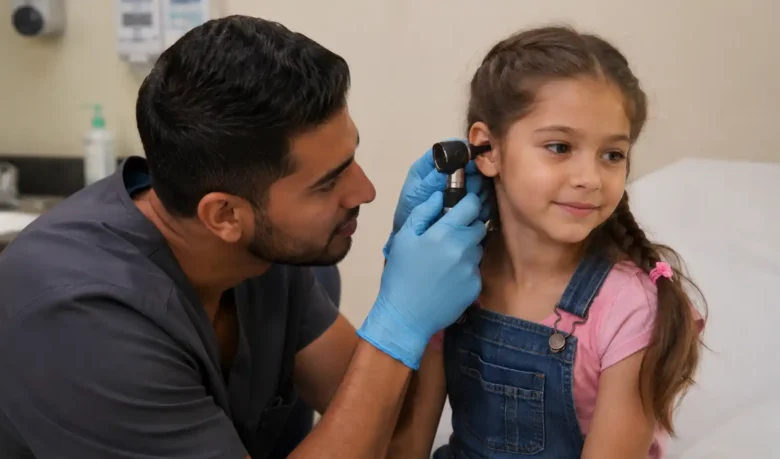
The otitis media vs otitis externa distinction is anatomical. Otitis media affects the middle ear behind the eardrum, while otitis externa affects the ear canal itself, the same territory most OTC moisture-control and cerumen-management products are designed for.
Otitis externa typically produces pain on manipulation of the outer ear, with a normal or partly visible tympanic membrane, while otitis media presents with a bulging, erythematous, poorly mobile tympanic membrane and no pain from external manipulation. This single finding is often the deciding factor in clinical assessment.
Otitis media can not directly become otitis externa. They are separate infections in separate compartments, although chronic middle-ear discharge through a perforation can irritate or secondarily colonise the external canal. It is also worth distributors knowing what is a red flag for otitis externa when training pharmacy teams: severe pain disproportionate to appearance, diabetes or immunosuppression, or signs extending beyond the canal all warrant urgent referral rather than self-care.
This is precisely where OTC category boundaries for ear care portfolios are drawn: prevention and maintenance of the external ear canal environment sit comfortably within OTC scope, while anything behind an intact or perforated eardrum does not.
Treatment divergence: antibiotics for otitis media vs OTC solutions for ear canal care
Otitis media treatment usually means systemic antibiotics for acute cases, with topical antibiotics used in some chronic presentations, always under prescription.
Otitis externa, and everyday ear canal care more broadly, is where the OTC portfolio actually sits, though the boundary is defined by presentation rather than by product strength. Antibiotic and steroid ear drops remain the appropriate route once an outer ear infection is confirmed and active. OTC ear canal products occupy the prevention role ahead of that point: managing moisture, supporting natural cerumen balance, and easing mild, non-infective irritation, keeping most canals in a condition where a prescription is never needed at all.
Thus, positioning OTC ear care vs otitis media means owning what happens before a prescription is ever needed: keeping the canal dry after swimming or showering, avoiding cotton buds and other invasive mechanical cerumen management that strips the natural barrier, and handling earwax build-up before it becomes impacted. These everyday habits are what keep most people out of the antibiotic cycle in the first place, and they are exactly the evidence base that belongs on a pharmacy shelf.
At Mitelos, our clinically validated ear care solutions, spanning moisture control, cerumen management, and canal irritation relief, are built around this preventive space, giving partners a portfolio that complements otitis media and otitis externa treatment pathways rather than overlapping with them.
Speak with our partnering team to explore how our range can strengthen your ear care offering!


References
Chong LY, Head K, Webster KE, Daw J, Richmond P, Snelling T, Bhutta MF, Schilder AG, Burton MJ, Brennan-Jones CG. Topical versus systemic antibiotics for chronic suppurative otitis media. Cochrane Database Syst Rev. 2021 Feb 9;2(2):CD013053. doi: 10.1002/14651858.CD013053
Institute for Quality and Efficiency in Health Care (IQWiG). Outer ear infection: Research summaries – Which ear drops help in the treatment of outer ear infections? [Internet]. Cologne: IQWiG; 2023 [cited 2026 Aug 14]. Available from: https://www.ncbi.nlm.nih.gov/books/NBK279352/
Klein JO. Otitis Externa, Otitis Media, and Mastoiditis. Mandell, Douglas, and Bennett’s Principles and Practice of Infectious Diseases. 2015:767–773.e1. doi: 10.1016/B978-1-4557-4801-3.00062-X
Mordor Intelligence. Acute otitis media treatment market size and share analysis – growth trends and forecasts (2025–2030) [Internet]. Hyderabad: Mordor Intelligence; 2025 [cited 2026 Aug 14]. Available from: https://www.mordorintelligence.com/industry-reports/acute-otitis-media-treatment-market